

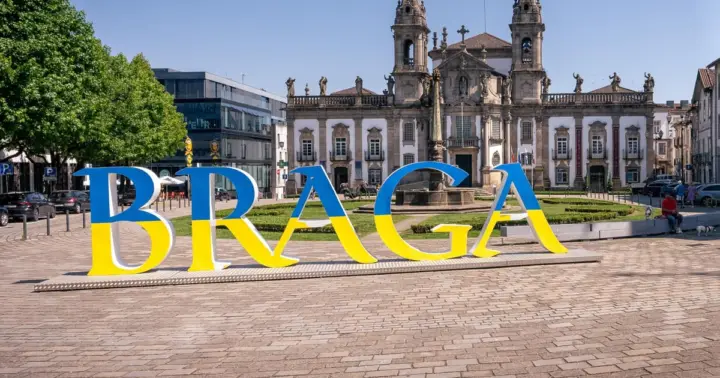
Braga combines a compact historic centre, a cathedral consecrated in 1089 and Bom Jesus do Monte—roughly 7.7 km from the centre—on the slopes of Mount Espinho. Most central sights fit into a walking route, while Bom Jesus and Sameiro require a bus, taxi or car. Here we organise the main stops into a practical sequence. To understand the city’s Roman, medieval and Baroque layers first, book a free tour in Braga. No credit card needed.
Last verified: August 2026 — Prices, opening hours, and reservation requirements checked against official sources. GuruWalk’s Braga guides reviewed the practical recommendations.
The best free tours in Braga for your first morning
A walking tour at the start of the trip places the cathedral, Santa Bárbara Garden, Arco da Porta Nova and Praça da República on one mental map. It also explains why the Roman name Bracara Augusta still appears across museums and archaeological sites. GuruWalk’s gurus provide the background, leaving the rest of the day free for interiors and hilltop sanctuaries.
A free tour has no fixed price: each guest leaves the amount they consider fair at the end. A useful guideline is €10–20 per person, rising to €50 for small groups or an exceptional guru. Choose an early departure when possible. You can then use the middle of the day for the cathedral and the afternoon for Bom Jesus or a museum.
Free Tour Braga – The first ones, since 2016. Come with us! Look for the green umbrella – MORNING AND…

Our Soul of Braga Free Walking Tour was launched to offer you the very essence of Braga . Gar…

My name is Tiago and I consider myself a true Braga lover! If Braga is beautiful by Day, it is…

What to see in Braga’s historic centre
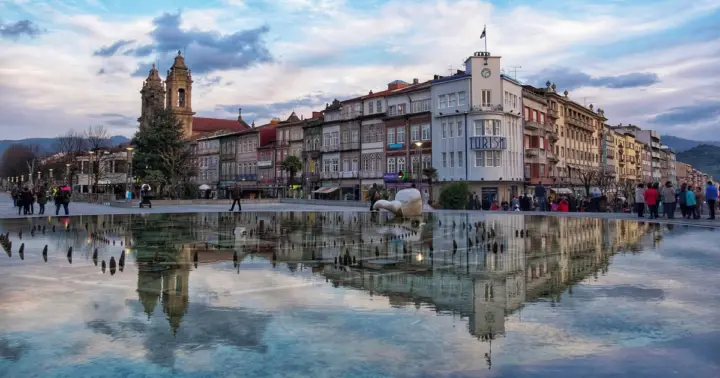
According to the official tourist map, most central sights lie between the railway station, Arco da Porta Nova, the cathedral and Avenida Central. A practical route needs no transport: Arco da Porta Nova, Rua do Souto, Praça da República, Santa Bárbara Garden, Largo do Paço and the cathedral. The official Visit Braga map also marks the former walls and museums.
Braga Cathedral and its Treasury Museum
“The oldest cathedral in Portugal,” the official city map said. Consecrated on 28 August 1089, the building combines Romanesque, Gothic and Baroque elements added over many centuries. Inside are the high choir, Baroque organs, several chapels and the Treasury Museum. Separate visitor routes cover different areas, so one standard ticket does not include everything.
As of August 2026, each normal route costs €3. Any two-route combination costs €6, while the joint ticket covering the Treasury Museum, chapels, high choir and cathedral costs €7. Published hours are 8:00–13:00 and 14:30–18:30; tourist visits pause during worship. The official Braga Cathedral ticket page lists prices and access conditions.
Santa Bárbara Garden, Largo do Paço and Arco da Porta Nova
Santa Bárbara Garden lies beside the former Archbishop’s Palace. A 17th-century fountain stands among the flowerbeds, with the palace’s Gothic wing behind it. Largo do Paço is only a few steps away, enclosed by historic buildings linked to the archbishopric and the university. Both are free outdoor stops between the cathedral and Praça da República.
To the west, Arco da Porta Nova marks one of the historic approaches to the city. Passing beneath it places you on the Rua do Souto axis, a pedestrian street that runs almost straight to the Arcada and Avenida Central. The railway station is about one kilometre from the cathedral, making the arch a convenient starting point for visitors arriving by train.
Praça da República and Avenida Central
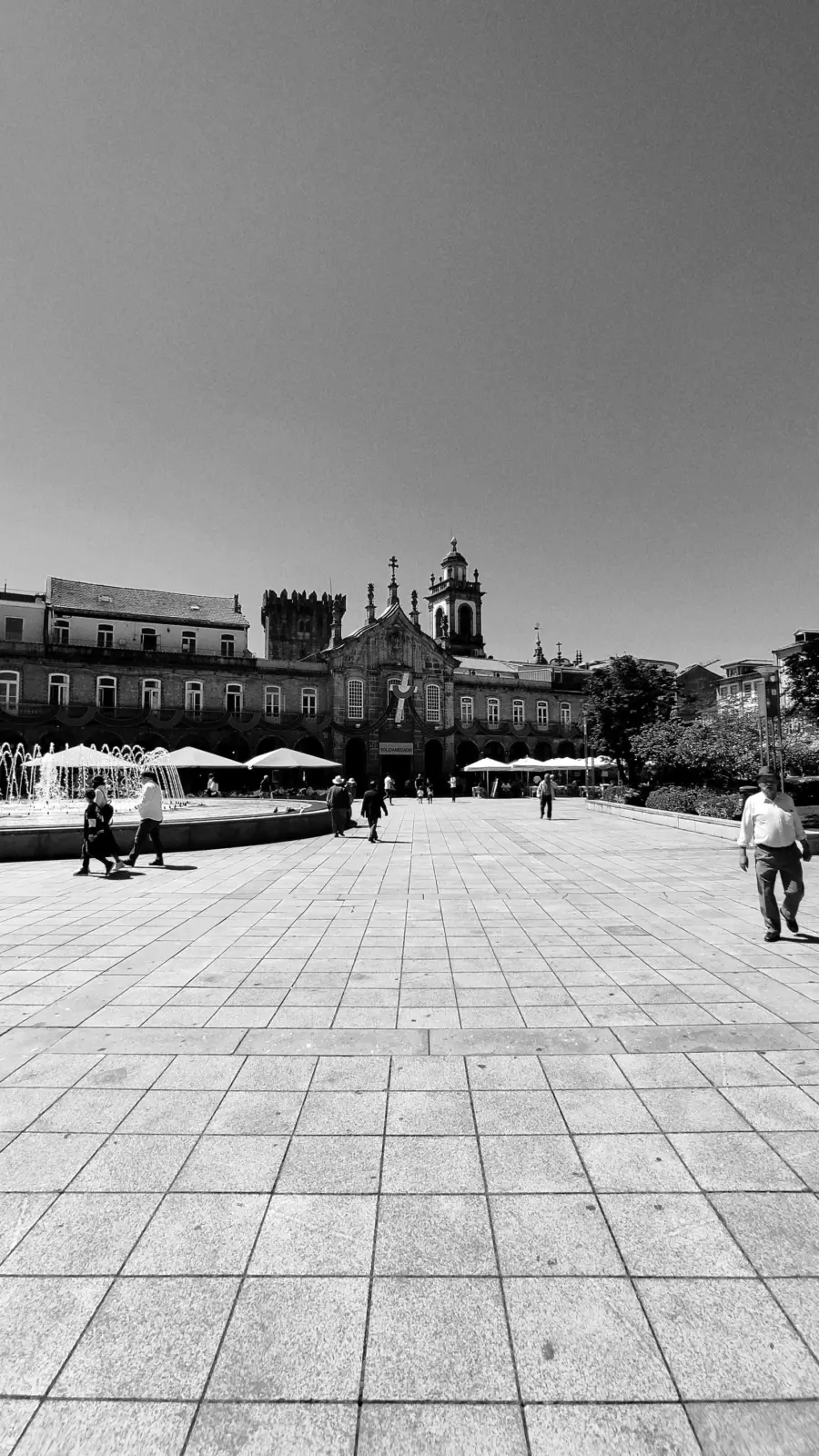
Praça da República marks the eastern end of Rua do Souto and links the old centre with Avenida Central. The Arcada frames one side, while Congregados Basilica stands beside the avenue. We use the square as a reset point: stop here, check the map and choose between the Bom Jesus direction and the archaeological quarter.
South of the square are Santa Cruz Church, São Marcos Church and Palácio do Raio. The walk between them is short, with religious façades, tilework and civic architecture all inside the pedestrian core. Travellers with only one morning can loop back towards the cathedral through parallel streets rather than retracing Rua do Souto.
Bom Jesus do Monte: stairways, basilica and funicular
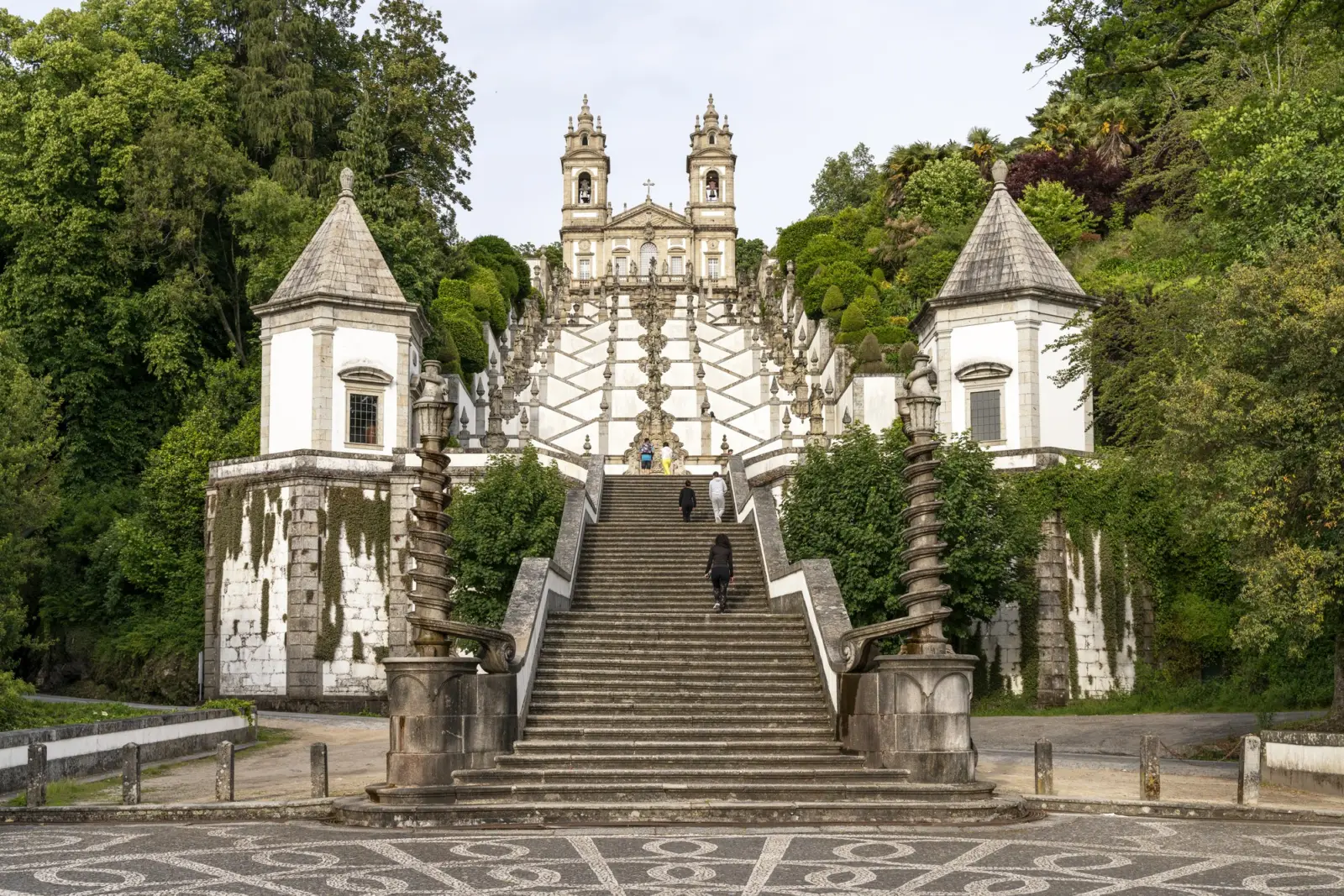
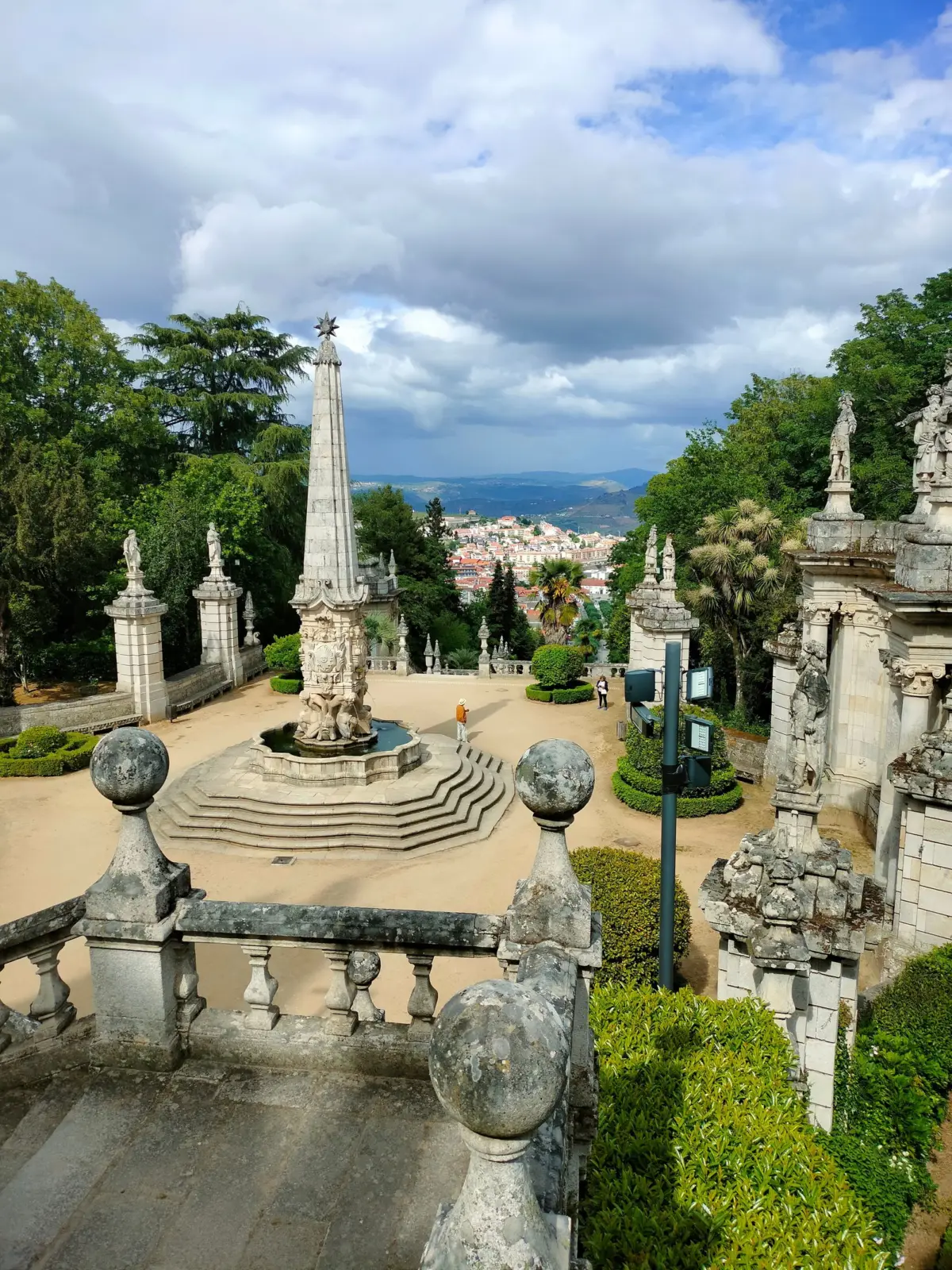
Bom Jesus do Monte stands outside the historic centre on a hill east of Braga. Developed over more than 600 years, the site is arranged as a sacred mount with Via Crucis chapels, allegorical fountains, gardens, stairways and a church at the summit. UNESCO inscribed it as a cultural landscape in 2019.
Walking uphill reveals the Portico Stairway, Five Senses Stairway and Virtues Stairway in sequence. Visitors who prefer to avoid the climb can use the funicular—a water-powered railway opened in the 19th century—for the steep section. Tickets cost €2.50 one way or €4 return in August 2026. The basilica opens daily from 8:00 to 19:00 in summer and until 18:00 in winter.
A €1 ticket covers the small museum space in the high choir and bell tower. Visits stop while religious services are taking place. The official Bom Jesus do Monte information page publishes seasonal times for the funicular, basilica and other services. We would allow two to three hours for the ascent, upper grounds and return journey.

Braga: Historical Walking Tour from the Romans to the Baroque




Braga: Family-Friendly Guided Tour and Self-Guided Quest
Steps with History: Photo Tour in the Heart of Braga
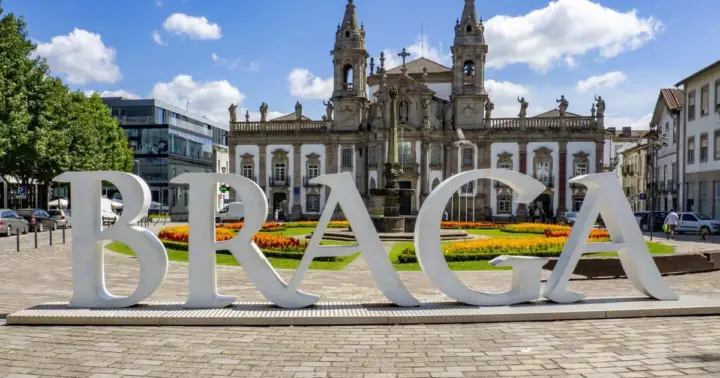
Hello Braga: Private 2-Hour Intro City Walk with Local Guide
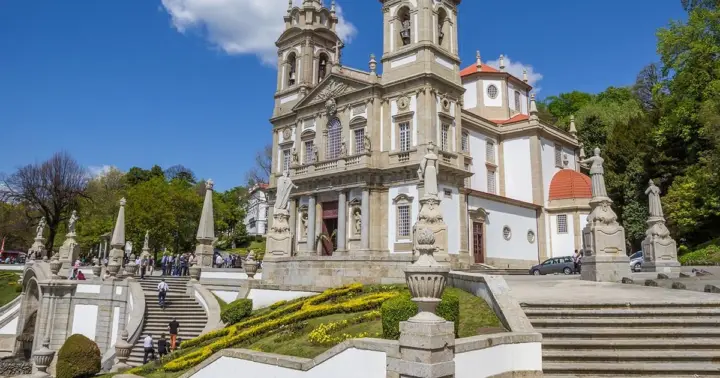
The Soul of Braga: Cathedrals, Palaces and Sanctuaries
Explore the Portuguese Rome, the City of Braga
Roman Braga and the Dom Diogo de Sousa Museum
Rome founded Bracara Augusta in 16 BC. The clearest place to understand that period is the Dom Diogo de Sousa Archaeology Museum, south of the centre. Its collections cover settlement before Roman rule, the Roman city and Late Antiquity, using objects recovered in Braga and the surrounding region.
Opening hours are Tuesday to Sunday from 10:00 to 17:30. Published general admission is €5, and children aged 12 or under enter free when accompanied by an adult. Check the official Dom Diogo de Sousa Museum information when planning. It is roughly a 15-minute walk from the cathedral.
Fonte do Ídolo and the Roman Baths of Alto da Cividade add archaeological stops, although access arrangements can change. If time is short, the museum provides a more continuous account than a route split across several sites. On a two-day stay, schedule this area for the morning after visiting Bom Jesus.
Biscainhos Palace and Braga’s Baroque architecture
Biscainhos Palace—a Portuguese residence developed in the 17th and 18th centuries—opens rooms that are very different from Braga’s churches. The route includes decorated interiors, stables, kitchens and a Baroque garden. Its location near Arco da Porta Nova makes it easy to add to a central walking route without a separate journey.
It opens Tuesday to Sunday from 10:00 to 12:30 and 14:00 to 17:30; last admission is at 12:15 and 17:15. In August 2026, the palace-and-gardens ticket costs €7.50, the palace alone €5 and the garden €3. The official Biscainhos Palace visitor page gives current discounts and closure dates.
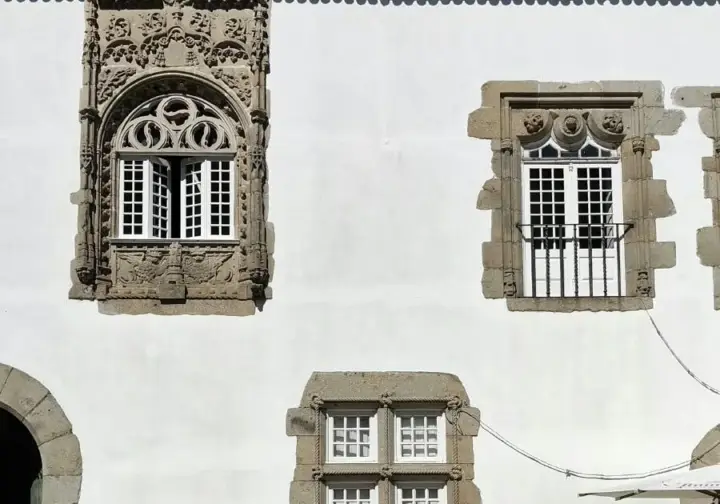
Another easy Baroque exterior is Palácio do Raio, identified by its blue-tiled façade. It stands south of Avenida Central on the way to the archaeology museum. Together with Santa Cruz Church, Casa dos Crivos and the Arcada, it shows how Braga’s medieval core changed during the 17th and 18th centuries.
Braga: Personal & Flexible Walking Tour in Historic Center
Braga: Historical Walking Tour from the Romans to the Baroque
Braga: Family-Friendly Guided Tour and Self-Guided Quest
Steps with History: Photo Tour in the Heart of Braga
Hello Braga: Private 2-Hour Intro City Walk with Local Guide
The Soul of Braga: Cathedrals, Palaces and Sanctuaries
Explore the Portuguese Rome, the City of Braga
Sameiro and Tibães on a second day
Sameiro Sanctuary is about 2–3 km from Bom Jesus according to the municipal tourist map. Its elevated position gives another view over Braga and the valley, but walking between both sanctuaries takes time and involves steep ground. By road, Sameiro works better as an extension of a Bom Jesus visit than as a separate trip from the centre.
São Martinho de Tibães Monastery lies northwest of Braga. It served as the mother house of the Portuguese Benedictine congregation and includes a church, monastic rooms and extensive grounds. The site is farther from the urban route, so reserve it for a two-day stay or a trip with a car.
One-day and two-day Braga itineraries
One day: begin with an early free tour. Visit the cathedral afterwards and have lunch in the centre. Use the afternoon for Bom Jesus, taking the funicular in one direction if you want to combine the historic railway with part of the stairway. Return to Praça da República at the end of the day.
Two days: keep the first day for the centre and Bom Jesus. On the second morning, we would visit the Dom Diogo de Sousa Museum and walk past Palácio do Raio. Choose Biscainhos, Sameiro or Tibães for the afternoon based on your interests and available transport.
Getting around and planning your budget
Central Braga is walkable. For Bom Jesus, the municipal map marks TUB routes 2 and 88. The 2026 base fare is €1.55 on board for one zone and €2 for two zones; a one-day tourist ticket for one person costs €3.35. Check the official TUB 2026 fare table before selecting a ticket.
Urban trains also connect Braga with Porto São Bento and Porto Campanhã. The station is west of the historic centre, close to Arco da Porta Nova. If you are making a day trip from Porto, confirm the final return service before heading to Bom Jesus; the sanctuary adds the urban transfer and two to three hours on site.
Frequently asked questions about Braga
How many days do you need in Braga?
One day covers the historic centre and Bom Jesus. Two days allow time inside the cathedral, at a museum and at Sameiro, Biscainhos or Tibães without rushing between visits.
Can you visit Bom Jesus for free?
Yes. The stairway and outdoor grounds can be explored on foot. The funicular is optional and costs €2.50 one way or €4 return according to prices checked in August 2026.
Do you need a car in Braga?
Not for the centre or Bom Jesus, which has a bus connection. A car is more useful if you plan to combine Sameiro, Tibães and other places in the Minho region on the same day.
Where should a Braga walking route begin?
Praça da República is the most practical central starting point. If you arrive by train, begin at Arco da Porta Nova and follow Rua do Souto to the square.
Plan your Braga visit
Start with context, leave enough time for the cathedral and keep a separate block for Bom Jesus. GuruWalk is the platform for finding and booking free tours with local guides and activities in cities around the world. Compare the free tours in Braga and browse activities and experiences in Braga.

GuruWalk
Travel marketing specialist with extensive experience in the travel sector. At companies such as Despegar and GuruWalk, she has led traveler-focused digital acquisition strategies. Now, from the GuruWalk blog, she combines her expertise with her passion for discovering and sharing unique destinations.